Export a truck or van from the Netherlands: registration and tax in Belgium
For businesses and private buyers bringing a van, pick-up or lorry from the Netherlands: when a van counts as a light goods vehicle in Belgium, which regional taxes apply, who needs an OBU, and what we arrange on the Dutch side.
- Two white plates for vans and trucks
- Heavy vehicles: price on request
- BPM refund service also for vans
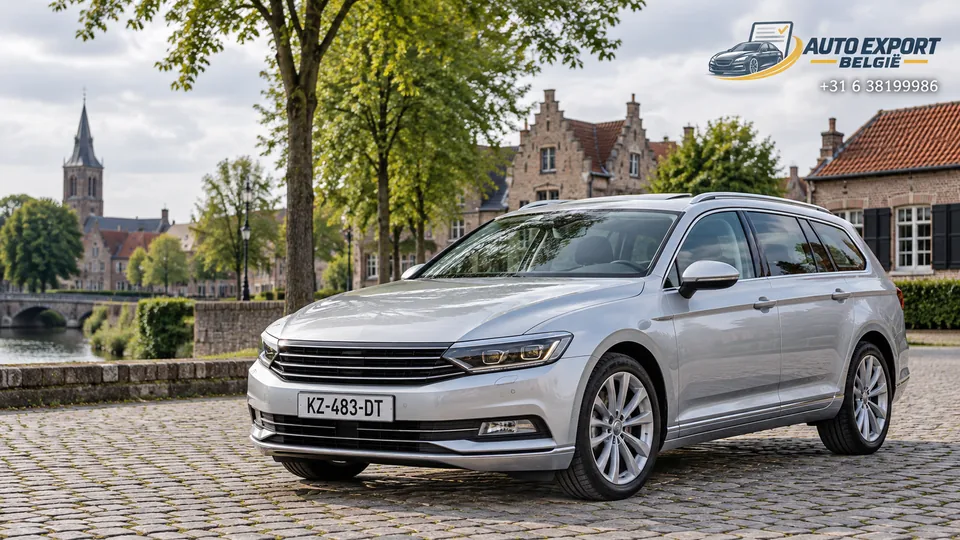
Vans, pick-ups and lorries from the Netherlands go through the same Belgian registration as a car, but how they are taxed depends on how the vehicle is built and how heavy it is. A van that misses one of the Flemish conditions for light goods vehicles is registered and taxed as a passenger car. Here is an overview based on the Flemish and Walloon tax pages, followed by what we arrange in the Netherlands.
When a van counts as a light goods vehicle
A light goods vehicle (lichte vracht in Flemish) has a maximum authorised mass (MTM) of no more than 3,500 kg. In Flanders it must also meet three conditions:
- The load space is always at least 50% of the length of the wheelbase.
- There is a fixed horizontal load floor without anchor points for extra benches, seats or seat belts.
- A partition completely separates the load space from the cab.
If the vehicle doesn't meet these conditions, it is registered and taxed as a passenger car. A pick-up only counts as a light goods vehicle when it is used professionally. Check this before you buy a van in the Netherlands, for example one with a second row of seats.
Van and lorry taxes in Flanders
Light goods vehicles and lorries pay no BIV in Flanders. The annual road tax for a light goods vehicle uses a base rate per 500 kg MTM, corrected for the Euro standard and a particulate filter, and indexed every year. Flanders has announced a 30% cut in that annual tax for light goods vehicles from 1 January 2027; like the wider reform of the annual road tax, it is still subject to final approval by the Flemish Parliament.
Lorries from 3,500 to 12,000 kg MTM pay no annual road tax in Flanders. From 12 tonnes they do, depending on the number of axles and the suspension, and a declaration is required. For the current rates, see the Flemish page on light goods vehicle taxes (in Dutch); we give no amounts.
Kilometre charge and OBU for trucks over 3.5 tonnes
All goods vehicles with a maximum authorised total weight (MTT) above 3.5 tonnes pay the kilometre charge, in Flanders, Brussels and Wallonia alike. Every vehicle that has to pay it needs a working OBU (on-board unit). The charge replaced the Eurovignette. The Flemish Tax Administration explains who has to pay the kilometre charge.
Wallonia and Brussels: declarations for heavy vehicles
Wallonia treats buses, lorries, tractor units, trailers and semi-trailers over 3,500 kg MTM as 'manual' vehicles for road tax, and the declaration must be submitted before the vehicle is used on public roads. Brussels also requires a declaration for certain vehicles, such as lorries, tractors and buses. How the TMC in Wallonia and the BIV in Brussels apply to a light goods vehicle is something to check with the regional tax service before you buy.
Inspection and registration of commercial vehicles in Belgium
A van or lorry follows the same steps as a car: the E705 vignette, a technical inspection before registration, Belgian insurance and registration with the DIV. The Flemish step-by-step page for vehicles from an EU country names the light goods vehicle in its title. bpost delivers the number plate within 24 hours of registration, at 30 euros per plate. Each step is explained on our page about registering a car in Belgium.
For periodic inspections, Flanders is moving vans and light goods vehicles gradually, between 2026 and 2028, to an inspection every two years.
Business buyers: VAT, company name and export papers
A VAT-registered business that buys a 'new' means of transport, with no more than 6,000 km or delivered within six months of first entry into service, includes the Belgian VAT in its periodic return. For a business buyer we need the company name, address and VAT number for the insurance and plates.
Would you like the company name on the Dutch export certificate? That is only possible at an RDW location, so not at our desk. We'd rather tell you now than at the counter.
Dutch export of a van or truck: plates, APK and BPM
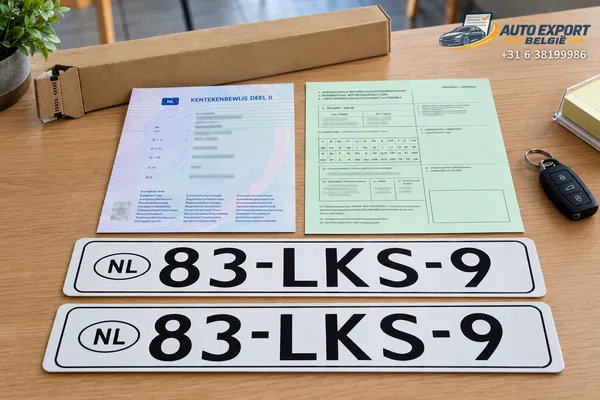
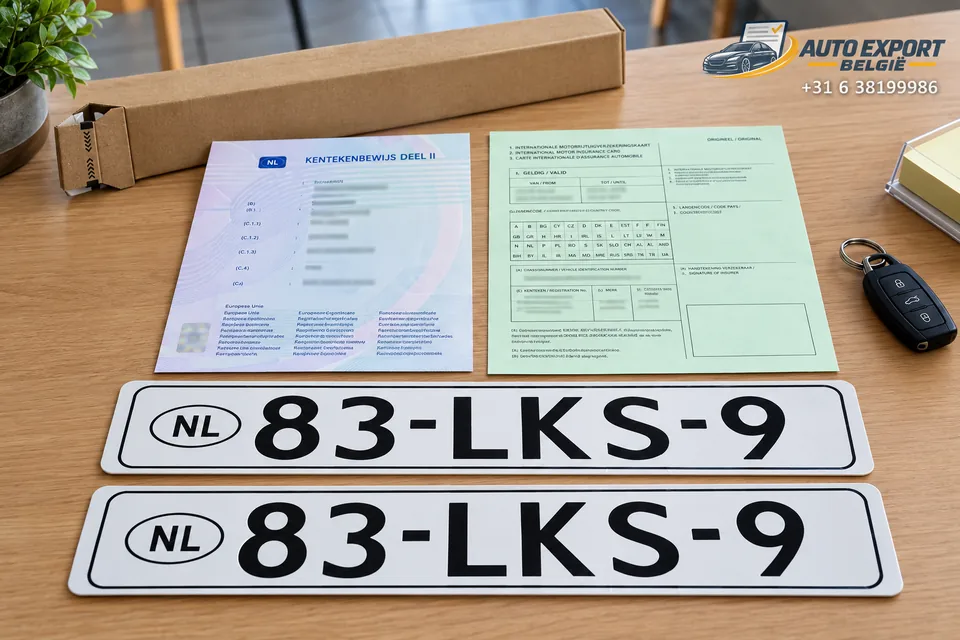
For the export trip, a van or lorry needs insurance and a valid APK (the Dutch roadworthiness test), and it gets two white export plates. For lorries and other heavy vehicles the price is on request, because insurance and handling costs can be higher. Belgium is in the EU, so no EX-A customs declaration is needed.
The refund of BPM, the Dutch registration tax, can also apply to a van, if it is registered in Belgium within 13 weeks of the export status and meets the other conditions. See our BPM refund service.
| Vehicle | Insurance required | APK (Dutch roadworthiness test) required | White plates |
|---|---|---|---|
| Car, van, truck or motorhome | Yes | Yes | 2 |
| Motorcycle, scooter or moped | Yes | No | 1 |
| Caravan or trailer over 750 kg | Yes, export insurance | Only above 3,500 kg | 1, with its own registration |
| Trailer up to 750 kg | Yes, on the chassis number | No | 1, with the towing vehicle's registration |
Sources: RDW (APK and export registration) and the Dutch government (registration plate of a trailer up to 750 kg). Export insurance for a caravan or trailer is part of our own export procedure. The export registration is valid for 14 days, but not beyond the APK expiry date.
Exporting today?
Call or message us for free advice or an appointment, also outside office hours. On Sundays a higher rate applies; you always know the price in advance.
Van and truck export questions for Belgium
When is a van taxed as a passenger car in Belgium?
In Flanders, when it does not meet the light goods conditions: an MTM of no more than 3,500 kg, load space of at least 50% of the wheelbase length, a fixed load floor without anchor points for extra seats, and a partition from the cab. It is then registered and taxed as a passenger car.
Does a van pay BIV in Flanders?
Not if it counts as a light goods vehicle: light goods vehicles and lorries pay no BIV in Flanders. A light goods vehicle does pay annual road tax, based on a rate per 500 kg MTM; lorries pay annual road tax from 12 tonnes.
Which trucks need an OBU in Belgium?
Every goods vehicle with a maximum authorised total weight above 3.5 tonnes pays the kilometre charge in all three regions and must have a working OBU.
Is an EX-A customs document needed to export a van to Belgium?
No. Belgium is in the EU, and within the EU no export declaration is needed. You do need the RDW export document, plus insurance and plates if the van is driven.
Can my company's name appear on the Dutch export certificate?
Only if the export is done at an RDW location. At our desk we do record the company name, address and VAT number of a business buyer for the insurance and plates.
Sources for commercial vehicle rules
- Vlaamse Belastingdienst: Verkeersbelastingen voor lichte vrachtwagens
- Vlaamse Belastingdienst: Verkeersbelastingen voor vrachtwagens
- Vlaamse Belastingdienst: Wie moet de kilometerheffing betalen?
- Service public de Wallonie: Paying road tax for "manual" vehicles (lorries, trailers, etc.), TCNA
- Vlaamse overheid: Technische keuring wordt eenvoudiger en minder frequent vanaf september 2026
- Vlaamse overheid: Een personenwagen, kampeerwagen, minibus, lichte vrachtwagen of aanhangwagen overbrengen van een EU-land naar België
Checked on 1 November 2026